Delete the useEffect that keeps your editor in sync.
TipTap for rich text and CodeMirror 6 for code, wrapped so the document is a writable signal. Toolbars, word counts and save buttons read it directly, and a write from outside lands in the editor without echoing back.
bun add @pyreon/rich-text @pyreon/code - rich text
- TipTap 3 on ProseMirrorMIT. The engine loads when
<RichText>first renders. - code
- CodeMirror 6Plus a diff editor, tabbed files and a minimap.
- languages
- 19 grammars, loaded on first useJS, TS, JSX, TSX and JSON by default; 14 more with
@pyreon/code/languages-all. - iOS and Android
- hosted in a WebViewNext release, experimental. Same TipTap and CodeMirror inside.
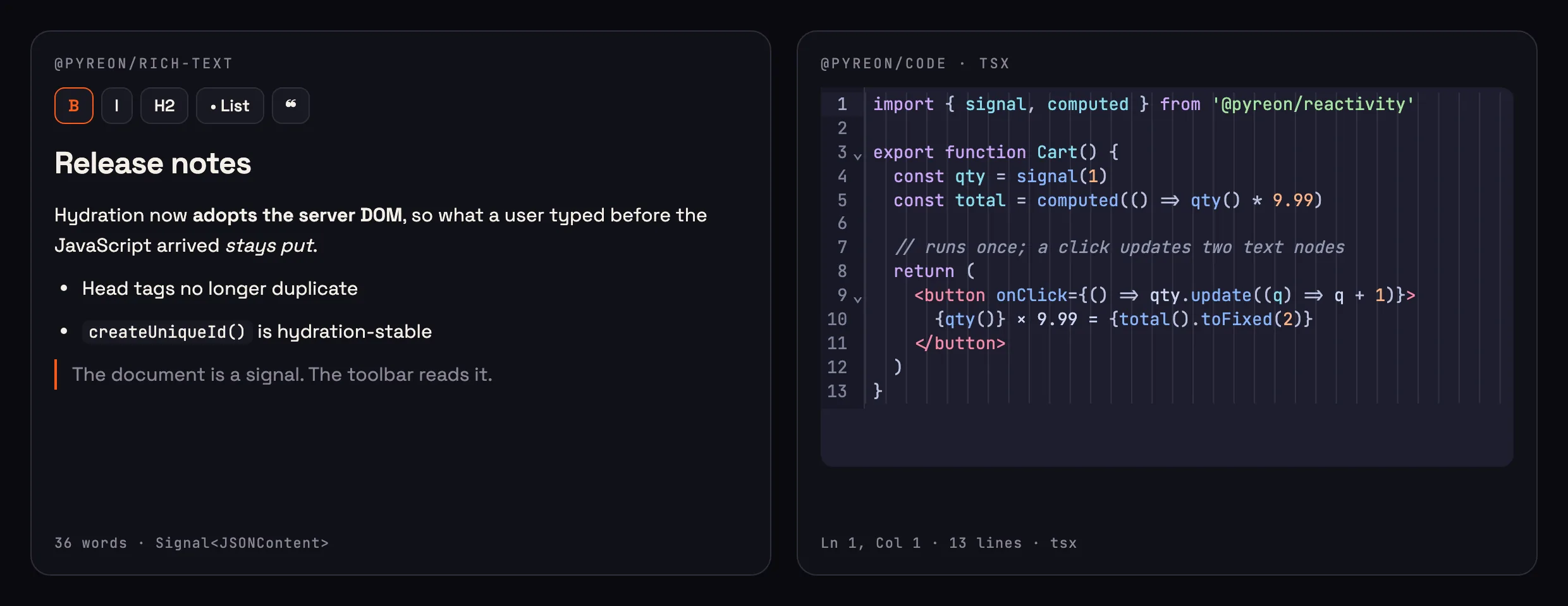
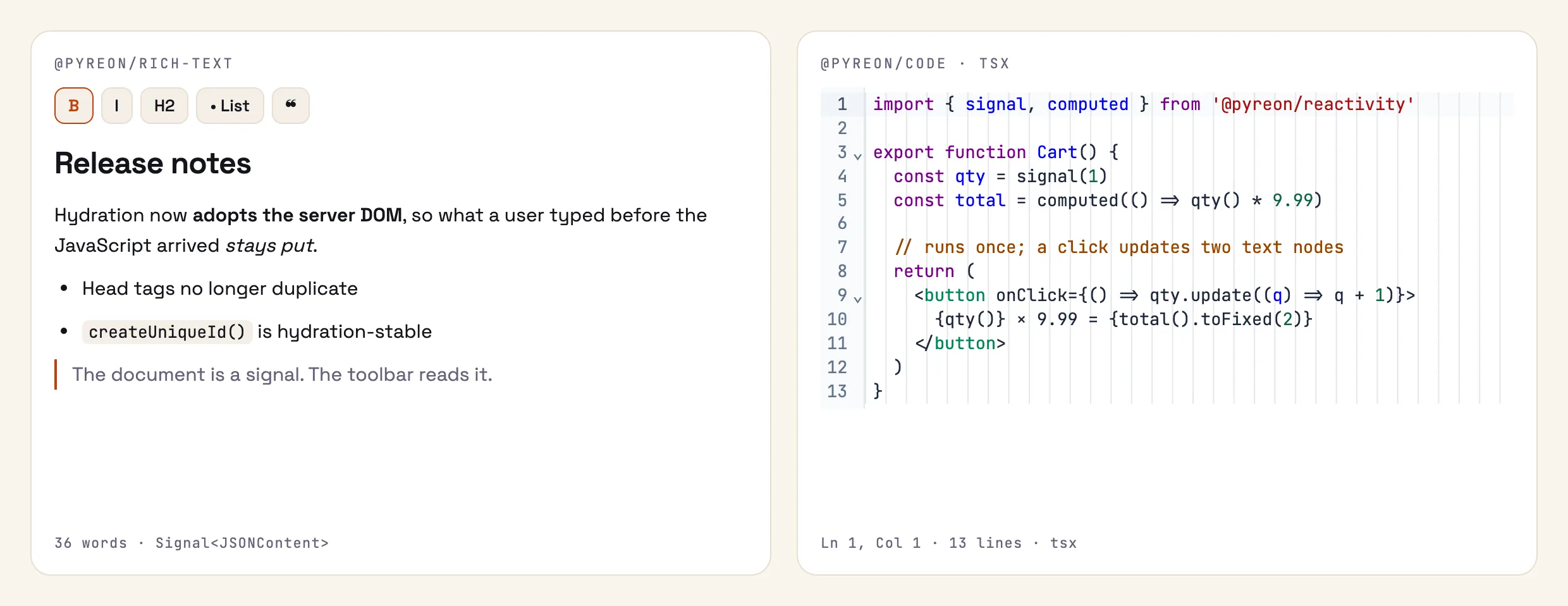
- 7 computed values on every rich-text editor: html, text, isEmpty, characterCount, wordCount, canUndo, canRedopackages/fundamentals/rich-text/src/types.ts (RichTextEditor)
- 19 code grammars, each fetched the first time it is usedpackages/fundamentals/code/src/languages.ts + languages-all.ts (getAvailableLanguages() returns 20 ids incl. plain)
- 3 code editors in the box: CodeEditor, DiffEditor, TabbedEditorpackages/fundamentals/code/src/index.ts
synthetic · author-run · M3 Max · record of 2026-11-05
Every result, including where we lose →The editor work you would otherwise write by hand.
The document is a signal
editor.json(rich text) andeditor.value(code) are writable signals. Read them anywhere and the UI follows; call.set()and the editor updates.One binding, no echo
bindRichTextToSignalandbindEditorToSignalkeep an editor and your store in step both ways with built-in loop guards. The code binding takesserializeandparse, so a JSON editor can drive a typed object and keep the last valid value while the user types.Counts before the editor loads
wordCount,characterCountandisEmptyderive from the document itself, so they are right before TipTap mounts. Moving the cursor does not re-run them;isActive('bold')still follows the selection.The same editors in your native appnext release
<CodeWebView>and<RichTextWebView>lower to a native WebView hosting the same CodeMirror and TipTap, andpyreon-native assetsbuilds the page for you. A round trip both ways is covered by the iOS and Android device tests.
Same TipTap. The sync code goes away.
An update handler, an effect that pushes outside changes back in without echoing, a JSON compare, and a selector hook for toolbar state.
import { useEffect } from 'react'
import { EditorContent, useEditor, useEditorState, type JSONContent } from '@tiptap/react'
import StarterKit from '@tiptap/starter-kit'

function PostEditor({ draft, setDraft }: { draft: JSONContent; setDraft: (d: JSONContent) => void }) {
  const editor = useEditor({
    extensions: [StarterKit],
    content: draft,
    immediatelyRender: false,
    onUpdate: ({ editor }) => setDraft(editor.getJSON()),
  })

  // Push outside changes in, without echoing our own edits back.
  useEffect(() => {
    if (!editor || JSON.stringify(editor.getJSON()) === JSON.stringify(draft)) return
    editor.commands.setContent(draft, { emitUpdate: false })
  }, [editor, draft])

  const ui = useEditorState({
    editor,
    selector: ({ editor }) => ({
      bold: editor?.isActive('bold') ?? false,
      words: editor?.getText().split(/\s+/).filter(Boolean).length ?? 0,
    }),
  })

  return (
    <>
      <button
        className={ui?.bold ? 'on' : ''}
        onClick={() => editor?.chain().focus().toggleBold().run()}
      >B</button>
      <EditorContent editor={editor} />
      <p>{ui?.words ?? 0} words</p>
    </>
  )
}The component runs once. The binding handles both directions; the toolbar and the counter read signals.
import { onUnmount } from '@pyreon/core'
import { signal } from '@pyreon/reactivity'
import { bindRichTextToSignal, createRichTextEditor, RichText, type JSONContent } from '@pyreon/rich-text'

const draft = signal<JSONContent>({ type: 'doc', content: [] })

function PostEditor() {
  const editor = createRichTextEditor({ ariaLabel: 'Post body' })
  const binding = bindRichTextToSignal({ editor, signal: draft })
  onUnmount(() => { binding.dispose(); editor.dispose() })

  return (
    <>
      <button
        class={() => (editor.isActive('bold') ? 'on' : '')}
        onClick={() => editor.chain()?.focus().toggleBold().run()}
      >B</button>
      <RichText instance={editor} />
      <p>{() => editor.wordCount()} words</p>
    </>
  )
}Coming from @uiw/react-codemirror or @tiptap/react?
A JSON config editor that keeps the last valid value
import { useCallback, useState } from 'react'
import CodeMirror from '@uiw/react-codemirror'
import { json } from '@codemirror/lang-json'

function ConfigEditor() {
  const [config, setConfig] = useState({ host: 'localhost', port: 3000 })
  const [text, setText] = useState(() => JSON.stringify(config, null, 2))
  const [error, setError] = useState('')

  const onChange = useCallback((value: string) => {
    setText(value)
    try {
      setConfig(JSON.parse(value))
      setError('')
    } catch (e) {
      setError((e as Error).message)
    }
  }, [])

  return (
    <>
      <CodeMirror value={text} height="300px" theme="dark" extensions={[json()]} onChange={onChange} />
      <p role="alert">{error}</p>
    </>
  )
}Both sides run CodeMirror 6. useEditorSignal disposes the binding when the component unmounts. Keep serialize deterministic: valid input is re-serialized, so formatting follows JSON.stringify(v, null, 2).
import { onUnmount } from '@pyreon/core'
import { signal } from '@pyreon/reactivity'
import { CodeEditor, createEditor, useEditorSignal } from '@pyreon/code'

const config = signal({ host: 'localhost', port: 3000 })
const error = signal('')

function ConfigEditor() {
  const editor = createEditor({ language: 'json', theme: 'dark' })
  useEditorSignal({
    editor,
    signal: config,
    serialize: (v) => JSON.stringify(v, null, 2),
    parse: (text) => {
      const next = JSON.parse(text)
      error.set('')
      return next
    },
    onParseError: (e) => error.set(e.message),
  })
  onUnmount(() => editor.dispose()) // CodeEditor does not dispose the instance it is handed

  return (
    <>
      <CodeEditor instance={editor} style="height: 300px" />
      <p role="alert">{error()}</p>
    </>
  )
}
useEditor + useEditorState become one instance
import { EditorContent, useEditor, useEditorState } from '@tiptap/react'
import StarterKit from '@tiptap/starter-kit'
import { Placeholder } from '@tiptap/extensions'

function Notes() {
  const editor = useEditor({
    extensions: [StarterKit, Placeholder.configure({ placeholder: 'Write a note' })],
    immediatelyRender: false,
  })
  const canUndo = useEditorState({
    editor,
    selector: ({ editor }) => editor?.can().undo() ?? false,
  })

  return (
    <>
      <button disabled={!canUndo} onClick={() => editor?.chain().focus().undo().run()}>Undo</button>
      <EditorContent editor={editor} />
    </>
  )
}Your TipTap extensions carry over through extensions: [...], appended after StarterKit. placeholder is built in.
import { onUnmount } from '@pyreon/core'
import { createRichTextEditor, RichText } from '@pyreon/rich-text'

function Notes() {
  const editor = createRichTextEditor({ placeholder: 'Write a note' })
  onUnmount(() => editor.dispose())

  return (
    <>
      <button disabled={() => !editor.canUndo()} onClick={() => editor.undo()}>Undo</button>
      <RichText instance={editor} />
    </>
  )
}Type and watch the signals.
The real @pyreon/rich-text editor. The meters on the right read the editor's own signals, and "Load from outside" writes the bound signal to show an external change landing without an echo.
- editor.wordCount()12
- editor.characterCount()63
- editor.isEmpty()false
- editor.isActive('bold')false
Counts come from the document JSON, so they are right before the editor engine has even loaded, and a cursor move re-runs none of them.
editor.json(), the document the bound signal carries, live in a CodeMirror editor whose value is a signal too.
Same engine, about the same weight.
Both wrap CodeMirror 6, so the size is mostly CodeMirror. We came out 4% heavier and print it. The Monaco row still fails to bundle, so there is no Monaco number here.
- core editor bundle (gz)131 KB126.4 KBloss4% larger
Two editors, one way of working.
- createRichTextEditor HTML or ProseMirror JSON in;
jsonis a writable signal out. - isActive() and chain() reactive toolbar state, and every TipTap command.
- editable as a signal flip a live editor to read-only with
editor.editable.set(false). - Accessible by default the content area is a labelled
role="textbox";placeholderreaches screen readers too. - createEditor code with signals for value, language, theme, cursor, selection and line count.
- DiffEditor side by side, or inline with accept and reject per change when editable.
- TabbedEditor multi-file editing; each tab keeps its own undo history.
- Diagnostics and gutters
setDiagnostics, line highlights and gutter markers for linters and debuggers. - Minimap, search, folding a canvas minimap, the search panel, fold all and unfold all.
- Vim and Emacs keys one flag each, loaded from an optional package only when switched on.
Things to build with it.
Bind the editor to an HTML string, save a second after the last keystroke, and show a character budget and an Undo that knows when it has nothing to undo.
import { onUnmount } from '@pyreon/core'
import { effect, signal } from '@pyreon/reactivity'
import { bindRichTextToSignal, createRichTextEditor, RichText } from '@pyreon/rich-text'

declare function saveDraft(html: string): Promise<void>

const body = signal('<p>Start writing…</p>')

function Composer() {
  const editor = createRichTextEditor({ content: body.peek(), placeholder: 'Write something', ariaLabel: 'Message' })
  const binding = bindRichTextToSignal({ editor, signal: body, format: 'html' })
  let timer: ReturnType<typeof setTimeout> | undefined
  const autosave = effect(() => {
    const html = body()
    clearTimeout(timer)
    timer = setTimeout(() => void saveDraft(html), 1000)
  })
  onUnmount(() => { clearTimeout(timer); autosave.dispose(); binding.dispose(); editor.dispose() })

  return (
    <>
      <RichText instance={editor} style="min-height: 12rem" />
      <footer>
        {() => editor.characterCount()} / 280
        <button disabled={() => !editor.canUndo()} onClick={() => editor.undo()}>Undo</button>
      </footer>
    </>
  )
}An inline diff of two signals. With readOnly={false} each change gets accept and reject controls.
import { signal } from '@pyreon/reactivity'
import { DiffEditor } from '@pyreon/code'

const saved = signal('export const limit = 10\n')
const edited = signal('export const limit = 25\nexport const retries = 3\n')

function Review() {
  return <DiffEditor original={saved()} modified={edited()} language="typescript" inline readOnly={false} style="height: 240px" />
}Two hosted editors in one component. pyreon-native assets builds the pages from the CodeMirror and TipTap your app has installed.
import { signal } from '@pyreon/reactivity'
import { CodeWebView } from '@pyreon/code/webview'
import { RichTextWebView } from '@pyreon/rich-text/webview'

const code = signal('let total = 0')
const note = signal('<p>Hello from the same source</p>')
const failure = signal('')

const Editors = () => (
  <>
    <CodeWebView
      state={() => ({ value: code(), language: 'typescript', readOnly: false })}
      onChange={(v) => code.set(v)}
      onError={(m) => failure.set(m)}
    />
    <RichTextWebView
      state={() => ({ content: note(), editable: true })}
      onChange={(text) => note.set(text)}
      onError={(m) => failure.set(m)}
      grow
    />
  </>
)Small APIs for both.
Every export has a reference page with its signature, an example and the mistakes people make with it.
- createRichTextEditor
- RichText
- bindRichTextToSignal
- JSONContent
- createEditor
- CodeEditor
- DiffEditor
- createTabbedEditor
- TabbedEditor
- bindEditorToSignal
- useEditorSignal
- loadLanguage
- registerLanguage
- getAvailableLanguages
- @pyreon/code/languages-all
- darkTheme
- lightTheme
- resolveTheme
- minimapExtension
- openSearchPanel
- CodeWebView
- buildCodeHostHtml
- RichTextWebView
- buildRichTextHostHtml
Good to know before you start.
You own the lifecycle
An editor you create is yours to dispose. Call editor.dispose() in onUnmount, and binding.dispose() too, unless you bind with useEditorSignal, which disposes the binding for you.
Install the grammars you use
Each language is an optional peer (@codemirror/lang-*). Install the ones you load; the rest never reach your bundle.
CodeMirror itself is not lazy
Grammars and TipTap load on demand, but the CodeMirror core ships in the chunk that imports @pyreon/code. Put a code-heavy page behind lazy() or a route split.
On native it is a web editor
The hosted editors are a WebView: expect WebView start-up time and web text editing, not a SwiftUI or Compose text field. Rich text hosts StarterKit; custom extensions need your own html page.
What people ask first.
Did you write your own editor engine?
No. Rich text is TipTap 3 on ProseMirror and code is CodeMirror 6, both MIT. Pyreon adds the signals, the bindings, the components and the native hosting. TipTap's paid Pro modules are not included.
Can I keep my TipTap extensions?
Yes. Pass them in extensions; they are appended after StarterKit, or set starterKit: false and bring the whole schema. editor.view() gives you the TipTap Editor once mounted.
How big is the code editor?
In our bundle run the core editor was 131.0 KB gzipped against 126.4 KB for @uiw/react-codemirror: the same CodeMirror 6, with us 4% heavier. Grammars come on top, one at a time.
Is real-time collaboration built in?
Not as a packaged integration. The pattern is TipTap's collaboration extension over a Yjs document, with createYjsDoc and syncedAwareness from @pyreon/sync/yjs for the document, transport and presence. You wire it; we do not test it end to end yet.
What changes on iOS and Android?
The editor runs in a native WebView, and <RichTextWebView>'s onChange receives the TipTap JSON as a string (a native handler cannot hold the object). On the web, JSON.parse it if you want the object. This lands in the next release and native targets are experimental.
Built to be used together.
Two real editors. Zero sync effects.
bun add @pyreon/rich-text @pyreon/code